
Be at home in yourself. Be free in the world.

Tag: health

  • What Happens When We’re Bored

    What Happens When We’re Bored

    Good morning. Or rather—good awakening.

    You’re probably reading this on your phone. That’s okay. So am I, as I write it.

    I’m not judging. But I’m curious—truly, deeply curious. What is it that draws you to that small black box with shiny lights?

    Let’s say that you’ve deleted the obvious – social media. So what now? What keeps pulling you in?

    I ask because I’ve seen it again and again: someone opens their phone looking for connection, or inspiration, or simply to pass a moment—and they find themselves trapped, dopamine drip by dopamine drip, in the very thing they thought they were escaping.

    You know it. I know it. We all do. It doesn’t make us bad. It makes us human. But here’s the paradox:

    When do I get most creative?

    When do the stories flow and ideas come?

    When I’m bored.

    Our nervous systems are designed to wander, to gaze out a window, to sit with silence and feel the soul emerge. But when every free moment is filled with someone else’s ideas, what room is left for our own?

    Phones can be tools. But the line between tool and trap is thinner than we think. And most of us crossed it long ago.

    The Cage With a Shiny Door

    In one of the early phases of the human experiment, rats were placed in a cage and trained to press a lever. Each press gave a small dose of dopamine—a sugar cube, a flash of light, a chemical hit.

    Fast forward to now. We’ve simply replaced the lever with a touchscreen.

    But here’s what’s different: the phone is not one addiction. It’s many. It’s a hydra of micro-hooks:

    • The need to be informed

    • The desire to be seen

    • The impulse to escape boredom

    • The craving for control or comfort

    These hooks override a subtle truth: that we need boredom. Boredom is sacred. It’s a doorway to dreamtime, vision, myth, real creativity. When we silence the outer world, the inner one can speak.

    So this isn’t a call to drop all technology. Quite the opposite.

    It’s a call to reclaim it—as a tool of awakening, not enslavement.

    You are not a rat. You are a sovereign being with a nervous system designed for wonder.

    And sometimes, the best thing you can do… is nothing at all.
  • Can Eating the Same Foods Every Day Affect Our Mood?

    Can Eating the Same Foods Every Day Affect Our Mood?

    I found myself pondering something the other day:

    Could eating the same foods, day in and day out, contribute to feeling low or even depressed?

    At first glance, it might seem trivial—especially if the foods are “healthy.” But I wonder if there’s something deeper at play. Not just nutritionally, but symbolically. Something the body is subtly telling us: “You’re stuck. You’re not moving. You’re living on habit alone.”

    As someone attuned to both internal states and lived patterns, I’ve noticed that when my meals become repetitive, I start to feel a kind of inner dullness—not necessarily hunger, but a lack of colour, rhythm, spark. Could it be that dietary monotony mirrors a deeper stagnation?


    1. The Body’s Nutritional Craving for Variety

    On a physiological level, there’s good reason to think variety matters. Even if we’re eating nourishing foods, repeating the same meals can lead to nutritional gaps over time. The body thrives on diversity:

    Micronutrients: Different foods bring different minerals, vitamins, and amino acids. Lack of variety can slowly deplete reserves, especially of trace nutrients like zinc, selenium, and B vitamins—all of which are linked to mood regulation.

    Gut Microbiome: A diverse diet supports a diverse microbiota, which plays a vital role in mental health through the gut-brain axis. In other words, your microbes might get bored too.


    2. The Subtle Psychology of Sameness

    But there’s more than biology here. There’s a quiet psychology—and maybe even a subtle energy—to it.

    Eating the same thing every day might be read by the psyche as:

    “Nothing new is coming. You are on autopilot.”

    And that message might quietly reinforce a sense of stuckness, lifelessness, or simply disconnection from the joy of experience.

    There’s a fine line between ritual and rut.

    • A daily bowl of porridge, made with care and intention, can be grounding.

    • The same bowl, made out of habit and eaten without presence, can feel like eating out of a grey loop.

    The food may not have changed. But the inner world around it has.


    3. A Doorway Back to Aliveness

    This isn’t a call to throw out everything familiar. It’s an invitation to play again.

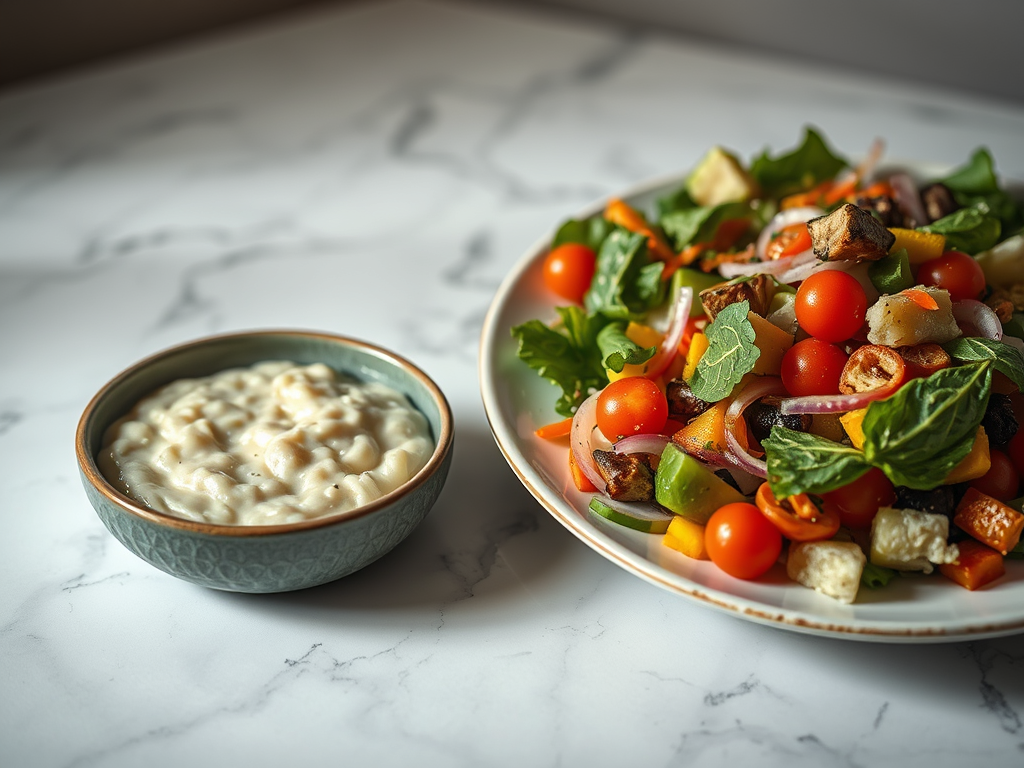
    Maybe add a splash of colour to the plate. Try a new herb. Cook with your non-dominant hand. Visit a different shop. Even small culinary shifts can reflect—and initiate—a larger inner movement.

    Sometimes, food is not just fuel. It’s feedback. It’s story. It’s a mirror.


    Final Thought: A Question Worth Exploring Further

    This musing might one day grow into a formal research topic—perhaps even a dissertation. For now, it lives as a quiet inquiry:

    What if how we eat, not just what we eat, shapes our state of mind?

    And what if variety isn’t just nutritional—

    but existential?